Whilst over in Madrid, I managed to find a decent record shop and got hold of a few obscure gems. The best and most intriguing of which was an LP I’d never before come across by the wonderfully-named DICK HECKSTALL-SMITH
The album also has a wonderful name, taken from a line in the poem ‘Four Quartets’ by TS ELIOT. It’s called:
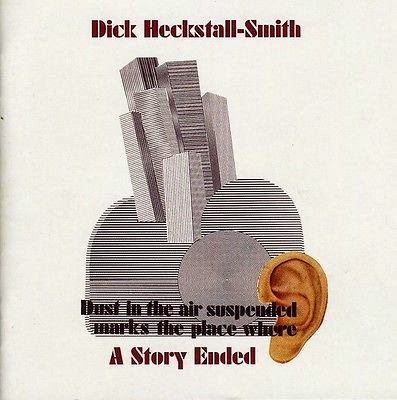
Released in 1972, it was came out on Warner Brothers in most territories but, pleasingly, this is a rare Spanish copy on Island Records.
Dick (Richard Malden) Heckstall-Smith was one of many musicians brought up on classical and schooled in jazz whose mind and musical oeuvre were expanded by the loose, free-spirited thinking of the ’60s; a time when musical distinctions became evermore blurred and multifarious creative experimentation became the norm. Heckstall-Smith studied agriculture at Sidney Sussex College, Cambridge and led the college’s jazz band.
Always something of a risk-taking maverick, he was a conscientious objector who eschewed national service and instead worked as a St. Bart’s hospital porter. In 1957 he became a jobbing musician, playing a Butlins’ summer season with clarinetist Sandy Brown (who’d awarded him a jazz prize while at Cambridge). He moved in trad-jazz circles for a while but he loved raw, bluesy roots music and the wild, wayward expressionism of be-bop, being greatly influenced by people like Rahsaan Roland Kirk (adopting his trademark party piece of playing two different saxophones at once) and as he’d developed his style playing with much louder, amplified rock and blues bands, his playing employed a more direct, fiercely blasted-out approach.
He played sax on an album by New Orleans trumpeter Bob Wallis and on that very same session was, according to Dick himself; “a flame-haired gangly young git with blue eyes who played drums like a wild animal” whose name was Peter Baker (‘Ginger’ to his friends). In 1961, he and Baker were regularly playing the Café des Artistes and Club Flamingo in Soho and soon hooked-up with Alexis Korner, the patriarchal British blues pioneer who pieced together Blues Incorporated, a raw, Chicago-style blues band that embraced elements of r&b and jazz.
Various hip young beatniks (Charlie Watts and Mick Jagger included) served time as members of Korner’s ever-changing crew until Heckstall-Smith, Ginger Baker, Jack Bruce and organist Graham Bond broke away to form the Graham Bond Organization, a prototype jazz-rock outfit of considerable clout. The Organization enjoyed transatlantic success until Baker and Bruce formed Cream with Eric Clapton, a former guitarist with the Bluesbreakers, led by John Mayall, who’d hired Heckstall-Smith to play on his seminal 1968 album ‘Bare Wires’. Also playing on that ‘Bare Wires’ album (along with future Rolling Stone Mick Taylor) was Jon Hiseman, the dextrous, powerhouse drummer who briefly took the place of Ginger Baker in the Graham Bond Organization before forming Colosseum, the progressive jazz-rock band of whom Heckstall-Smith was a also founder member.
In the album’s scant sleeve notes, our Dick reveals; ‘When we all met in a pub and decided to end Colosseum, I said I wanted to make a solo album. Well, here it is’.

Helping him out were four fellow Colossi; vocalist Chris Farlowe, Mark Clarke on bass, keyboardist Dave Greenslade, who would later form his own eponymous prog-rock band, and Jon Hiseman (who also produced the album).
Also featuring amongst the myriad personnel were:
Chris ‘Motorbiking’ Spedding, the go-to session guitarist of choice (who at the time was cutting his jazz-rock chops with Ian Carr’s Nucleus), Graham Bond, the ORGANiser of Dick’s old band, Paul Williams; NOT the singer/songwriter responsible for the songs in Bugsy Malone. This dude was vocalist in Juicy Lucy and Tempest, the next jazz-rock band Jon Hiseman and Mark Clarke formed after Colosseum’s dissemination.
Also featuring is Caleb Quaye, the older half-brother of Finley Quaye and a valued alumnus of Elton John’s ’70s band who played on Elt’s ‘Rock Of The Westies’ & ‘Blue Moves’ albums. Tying things in nicely, in an almost incestuous display of chummy camaraderie, the lyrics on the album were written by Pete Brown, lead singer of not one but two hippy art terrorists signed to Harvest Records; Piblokto! & The Battered Ornaments (featuring Chris Spedding on guitar). Brown was a talented, delightfully dippy lyricist who wrote the words to a handful of classic Cream songs including ’Sunshine Of Your Love’, ‘White Room’ and ‘Badge’.
Enough of the personnel, what about the music…?
‘Future Song’ kicks things off with a ‘Voodoo Chile’-like chaka-waka intro and a driving funk-infused riff over which our Dick bleats out some hot-as-hell honkin’ and offbeat jazzy chord sequences until the song fades out, annoyingly enough, just as a smoking guitar solo breaks out.
‘Crabs’ is a passionately-wrought mid-paced burner that soon jolts into life, picking up a double-time tempo, sliding subtly back into the slower pace and back again with clattering percussion and plonking piano.
‘Same Old Thing’ then staggers into view with heavy eyelids hiding dilated pupils and bloodshot eyes, sporting a nicotine-stained beard, it’s a smoky, worse-for-wear English blues with a Hendrixian vibe, the recurring motif recalling ‘Wind Cries Mary’.
‘Was The Morning After’ is more wistful, like something faux-meaningful from ‘Hair’ or ‘Jesus Christ Superstar’ which gets faster and more fidgety during the middle section.
‘Pirate’s Dream’ is the killer track though. Boasting busy, supple drumming throughout, it has a classic, descending rock riff and a remarkable vocal performance from Chris Farlowe who spouts out a volley of verbose mouthfuls from the impenetrable, poetically pithy pen of Pete Brown. There’s a frenzied drum-led acceleration of delivery which soon settles down into a more tempered, jazzier section in which Hiseman shows he’s not all about crash ’n’ clatter and can play with subdued restraint.
Some smart dual interplay mimicry from Dick & Chris Spedding on guitar, as Hiseman and bassist Mark Clarke slowly ensure the song gradually ups both the pace and the level of intricacy before locking down into an irresistibly fluid blues-jam groove.
You hear some soaring vocal histrionics (by an uncredited female) and Graham Bond mewing and squelching forth some otherworldly squawks and squelches from what would then have been a strange, newly-acquired keyboard gizmo bearing the legend ‘Moog’.
Here, treat yourself to a good listen:
Finally, there’s ‘Moses In The Bullrushes’, a swingin’ jazz-pop finger-clicker with a gobful of garbled lyrics that concludes proceedings on a suitably energetic note.
This album must’ve seriously blown some music-loving minds in ’72. Such a great ensemble piece, very typical of the time; jazz-trained musicians gleefully showing off their collective chops by playing each individual instrument to the limit of its capability.
Breathtaking in parts. Popular music made within a rock framework yet with some very jazz-minded chord structures and shape-shifting polyrhythms. Every participant playing for the thrill of it, pulling off dazzling performances just because they know they’re good enough to be able to with epic ease.

 Randomia Hebditica
Nice post. I learn something totally new and challenging on websites I stumbleupon every day.
It will always be helpful to read through articles from
other writers and practice something from their web sites.
LikeLike